Dog Barks at the Mailman and Guests - Causes and How to Fix It

Dogs bark at the mailman and guests mainly because of territorial instinct combined with an accidental reinforcement loop - the dog barks, the person leaves, so the dog learns that barking works. This can be changed through systematic desensitization and counterconditioning: gradually exposing the dog to the trigger while rewarding calm behavior. For strong reactivity or any sign of aggression, consult a certified behaviorist.
Doorbell rings. Dog explodes. Barking, spinning, launching at the window to see what's happening. By the time you've collected your parcel and closed the door - your dog is convinced it just saved your home from a very suspicious person in a high-vis jacket. And tomorrow it will do exactly the same thing.
Why dogs bark at the mailman - the reinforcement loop
Territorial barking is one of the most natural canine behaviors. Your home is your dog's territory, and any unfamiliar person approaching the entrance triggers an alert response. It's not defiance - it's evolution.
The problem is that the dog accidentally discovers that barking works. The mail carrier arrives, the dog barks, the mail carrier leaves. From the dog's point of view, the math is obvious: my barking drove off the intruder. Every delivery repeats the lesson. Within weeks you have a dog that reacts to the sound of the gate or the glimpse of a uniform from across the street.
Three main reasons dogs bark at the mailman and guests:
| Cause | What it looks like | What the dog feels |
|---|---|---|
| Territorial instinct | Barks at fence, window, or door | Guarding the home, sounding the alarm |
| Escape-reinforced behavior | Barks, person leaves, dog calms down | Belief that barking is effective |
| Over-arousal or frustration | Barks and paces, tail raised | Wants contact but a barrier blocks it |
Each variant calls for a slightly different approach, but the starting point is always the same: break the loop and teach the dog that calm behavior earns better rewards.
What doesn't work - and why
Before the training steps, a quick note on three common mistakes that make things worse.
Yelling at the dog. Your dog reads your shout as joining the alarm - "the pack leader is barking too, this really is a threat." The result is the opposite of what you want.
Letting the dog rush to greet the guest right away. At peak arousal the dog can't greet calmly - it jumps, barks at close range, overwhelms the guest. The guest steps back, the dog 'wins' another round.
Locking the dog in another room every time. This manages the symptom, not the cause. The dog learns nothing new, and frustration builds up between sessions.
Desensitization and counterconditioning - step by step
Desensitization means gradually exposing the dog to the trigger at an intensity where it stays calm. Counterconditioning means building a new positive association with that trigger. Both techniques work together.
Step 1 - find the reactivity threshold
This is the distance or intensity at which your dog first reacts. If your dog barks at the sound of the gate, start with a recording of that sound played very quietly in another room. If it reacts to the sight of someone outside the fence, start with a person standing further away than the usual trigger point.
Golden rule: always train below the reactivity threshold. The dog should be aware of the trigger but not react to it. Only then is real learning possible.
Step 2 - pair the trigger with something great
The moment the trigger appears - the sound of a doorbell, a knock, a person approaching - immediately give the dog a high-value treat. When the trigger disappears, the treats stop. The dog starts associating: "that sound means something delicious is coming." That is counterconditioning.
Step 3 - gradually increase the intensity
Once the dog consistently stays calm at a given level, gently raise it. A louder sound, a person a little closer, someone approaching the door a bit faster. Never jump two steps at once. If the dog starts reacting, go back to the safe level.
Step 4 - practice with a helper
Ask a friend to play the role of mail carrier. They approach the door, ring the bell, and wait - but they do NOT leave while the dog is barking. Only once the dog quiets down and disengages does the 'visitor' step back. Immediately reward the dog. This is crucial: the person leaving while the dog barks resets the old loop.
Build on this by teaching a place behavior - when the doorbell rings, the dog goes to its mat and gets a treat there. Practice the mat cue many times separately before connecting it to the door routine.
When to call a certified behaviorist
The techniques above work well for territorial barking and over-arousal. But some situations call for professional support - and attempting them alone can make things worse.
Consult a certified animal behaviorist if:
- barking is accompanied by growling, teeth-baring, or attempted biting,
- the dog stays highly aroused for a long time after the trigger and cannot settle,
- the behavior is getting worse despite weeks of consistent training,
- the dog has a guarding or protection background where the behavior is deeply conditioned.
It's also worth reading up on dog aggression - if you're unsure whether your dog could harm someone, don't wait.
How socialization prevents the problem
Dogs that are well socialized from puppyhood - regularly exposed to different people, uniforms, large bags, delivery boxes - rarely develop intense territorial barking. If you have a puppy, arrange calm encounters with a variety of people, including those in hi-vis vests or carrying packages.
With an adult dog that had limited early exposure, stopping the barking takes longer - but it's absolutely possible. Patience and repetition are your best tools.
Day-to-day practical tips
A few things you can start today with no specialist equipment:
- When you head out to check the post box, take treats. If the dog is calm during the ritual, reward that.
- When you're waiting for a courier, set up the dog's mat near you and reward every quiet moment spent on it.
- Reduce visual access to the street - frosted film on the lower portion of windows or a drawn curtain lowers the arousal that builds before any training session has a chance to kick in.
- Ask your mail carrier if they're willing to drop a treat through the letterbox along with the post - some do, and the effect can be surprisingly fast.
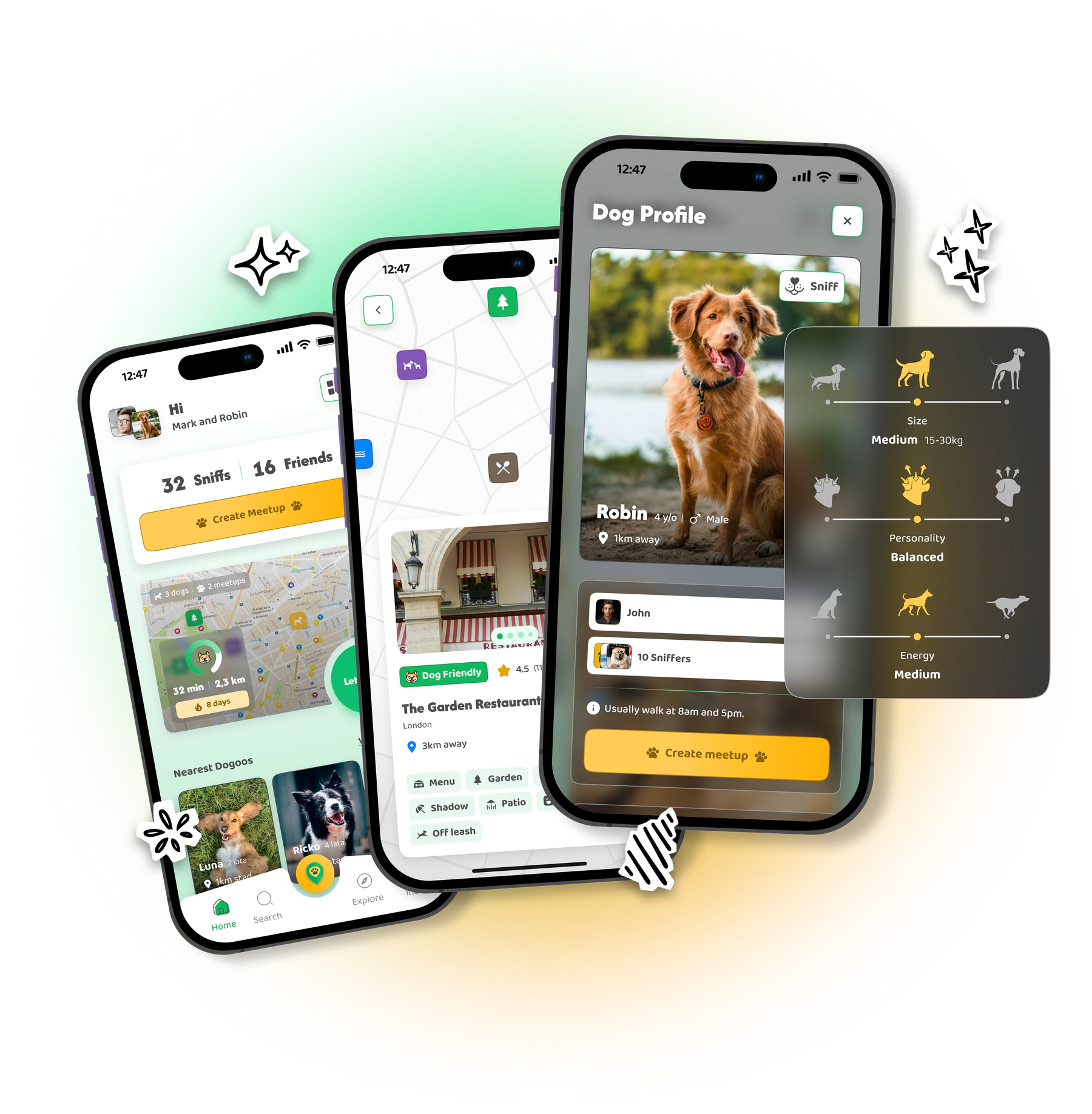
The best long-term fix for a reactive door-dog is more time out in the world. A dog that regularly meets different people on walks is a calmer dog at home. Check the DOGOUT map for off-lead areas and dog-friendly spots near you - great places to practise calm encounters at your dog's own pace.
Frequently asked questions
- Why does my dog bark specifically at the mailman and not other people?
- Mail carriers visit on a predictable schedule, approach the home, and then leave right after the dog barks. From the dog's perspective, barking worked - it drove the intruder away. This accidental reinforcement happens every single day, making the behavior stronger over time.
- Is a dog that barks at guests being aggressive?
- Not necessarily. Many dogs bark from territorial instinct or over-arousal without any intent to harm. However, if the barking is accompanied by growling, raised hackles, or snapping, consult a certified animal behaviorist - those signals indicate a more serious concern.
- How long does it take to stop a dog barking at the mailman?
- With consistent training several times a week, many owners see real improvement within 2-4 weeks. Dogs with a long history of the behavior may take several months. Consistency matters more than frequency - short daily sessions beat occasional long ones.
- Should I punish my dog for barking at the mailman?
- No. Punishment increases stress and can deepen the fear or anxiety that drives the barking in the first place. Training an incompatible behavior - like going to a mat - combined with positive reinforcement produces more reliable and lasting results.
- Can I let the dog greet the mailman to fix the problem?
- Only once the dog is calm and has been introduced to the mail carrier gradually. Forcing a meeting while the dog is highly aroused often backfires - the dog jumps, barks at close range, and the mail carrier understandably retreats, rewarding the behavior again.
- What if my dog barks at guests inside the house?
- Teach a specific place behavior - a mat or bed the dog goes to when the doorbell rings. Train the 'go to your mat' command separately first, then gradually introduce the doorbell as the cue. Reward the dog on the mat before you open the door.